Be yourself; Everyone else is already taken.
— Oscar Wilde.
This is the first post on my new blog. I’m just getting this new blog going, so stay tuned for more. Subscribe below to get notified when I post new updates.
Be yourself; Everyone else is already taken.
— Oscar Wilde.
This is the first post on my new blog. I’m just getting this new blog going, so stay tuned for more. Subscribe below to get notified when I post new updates.

No team regardless of the talent and strength of the team they are playing wants to be on the losing side of a game or competition. In the age of the web it is become increasingly common over the last 10-15 years for people to create a meme of a memorable or infamous call or play from a game or event. This one specifically highlights four NFL Playoff games and the play, result, or call that was most remembered by sports fans across the world. In order from top-bottom, left to right: The 2018 NFC Championship Game, 2018 NFC Divisional Round, 2018 NFC Wild Card Game, and the 2018 AFC Championship Game. Most of you have probably noticed a theme from all four of these games, but if you haven’t spotted it, all four of these games took place in the same year and same playoffs for the NFL. It’s rare when there is one game in the playoffs that can captivate such a large audience and spark meme creations all around the world, but having four games where that is possible is almost unheard of.
The top left picture of this meme, the meme is centered around the 2018 NFC Championship Game between the Los Angeles Rams and The New Orleans Saints. The Saints had finished the regular season with a 13-3 record which guaranteed them home field advantage throughout the playoffs. The Rams had also finished the regular season with a 13-3 finish but due to tie breaker scenarios were given the number 2 seed in the NFC. This set up the Saints to play the winner of the Rams and Cowboys in the NFC Championship game which ultimately ended in a Rams victory meaning either the Rams or Saints would represent the NFC in the Superbowl. The meme titled” The no call” references a play late in the fourth quarter where Rams corner back Nickell Robey- Coleman made contact seconds before the ball was even in the reach of Saints receiver Tommylee Lewis, and in most instances this would qualify as defensive pass interference. In this instance there was no call and this forced the Saints to kick three giving them a 23-20 lead with 1:26 remaining in the game. The Rams would drive down the field and kick a field goal to tie the score as time expired in the 4th quarter which meant overtime in the NFC Championship Game. The overtime session would start with the Saints and future hall of fame quarterback Drew Brees with a chance to send the Saints into the Superbowl; It ended with a Drew Brees getting intercepted by John Johnson of the Rams setting them up on their own 46 yard line and eventually kicking the game winning field goal. It was controversial, it was seen by millions, and it eventually made its way into meme status.
The top right picture highlights a play in which Eagles wide receiver Alshon Jeffery dropped a pass thrown by Nick Foles which slipped out of Jeffery’s hands and into the hands of Saints cornerback Marhson Lattimore. The Eagles were down 20-14 and had a chance to score but their seasons hope of staying alive was dashed after Alshon Jeffery dropped the ball at one of the most crucial times not just in the football game but in his Career.
The bottom left picture is titled “Double Doink” and is used to describe the way Bears kicker Cody Parkey kicked a 43-yard field goal which was deflected by Eagles defensive tackle Treyvon Hester and knocked off the vertical and horizontal uprights of the goal post and was then referred to by NBC broadcaster Cris Collinsworth as a “double doink”.
The bottom right meme just reflects that the Patriots under future first ballot Hall of famer Tom Brady and the New England Patriots would be returning to the Super Bowl after defeating up and coming superstar Patrick Mahomes and the Kansas City Chiefs for a shot to win their sixth Super Bowl in 17 seasons. They would go on to beat the Los Angeles Rams 13-3 and Brady and the New England Patriots would earn their 6th title in 17 seasons and third in five years. All four of these memes were made about the absurd finishes, calls, and plays of the 2018 NFL playoffs and proved that you truly never know whats going to happen before its finished.

Going once, going twice, going three times, and sold to the gentlemen sitting on his couch in Omaha, Nebraska. It can be done from anywhere, at anytime, and usually a sports passion or hobby of collecting is in order to enjoy the services of this app. Sports Collectibles Auction is an e-commerce site and mobile app that holds bidding wars otherwise known as auctions on memorable and highly valued pieces of authentic sports memorabilia. This app will help any collector or sports fanatic fulfill their love for the two hobbies by giving them a chance to be the highest bidder on items put on the mobile app and online by Sports Collectibles Auction.
Each item that is put on display for an auction is equipped with its own landing page and is alluded to as a “Lot”. When a user clicks into the item they’d like to consider putting a bid in for, they are brought to a landing page that includes an image of the piece of memorabilia that is being auctioned off, a description of the item, name of the person the item is dedicated for, the condition of the piece, and a starting bid price. People are allowed to start bidding anytime after the auction for the item has been announced live. People have a chance to enter an amount over the starting bid right from their cell phone on this exceptionally well optimized mobile app and are able to make another bid when or if their’s bidded over. When the time frame given for the auction runs out, the highest bidder can either pick the item up from the seller or have it delivered. While the aspect of an auction being completely digital is an offering of Sports Collectibles Auction, some of the lots displayed on the mobile app allow people to attend a live and in person auction with the option to bid right from a person’s cell phone.
For auctions that are held as a live and in person event, Sports Collectibles Auction will promote the event in the digital description of the the item that is being auctioned off. Sports Collectibles Auctions gives people the opportunity to bid on the item being sold from the comfort of their own home with the option to pick the item up if they end as the highest bidder, or people can go to the physical location where the auction is being held and bid on the item they are seeking in person. Sports Collectibles Auction is a mobile app that offers a wide variety of sports memorabilia and collectibles for people to bid on and the price range on the starting bids makes some of their inventory very affordable for the average Joe or middle class income citizen. If there is a sport, a team, or a city that you are found of or you just enjoy collecting for the pure sake of collecting, Sports Collectibles Auction is the app for you and is available for purchase on whatever app store is the primary app store for your mobile device.

St. Louis, MO- A city that played host to an NFL team called the Cardinals from 1960- 1987 before relocating to Tempe, AZ in 1988 and being renamed the Arizona Cardinals. For six years the city of St.Louis was without a professional football team, but in 1994 the Los Angeles Rams relocated east to the city of St.Louis where they became the St.Louis Rams and recaptured the love and pride for football in a city that has taken great pride over the years for their professional sports teams. While the team’s initial success was limited while the team never managed to post a winning or .500 record for their first five seasons of play in St.Louis, like the Budweiser Brewing Company, the Rams would be brewing up a winner that would be recognized by the entire football soon after the 1999 season as the “Greatest Show on Turf”.
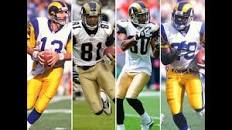
In 1999, The St.Louis Rams started the preseason with Trent Green as their number one quarterback on the depth chart with their backup being future hall of fame quarterback, Kurt Warner. Warner has been on the Green Bay Packers practice squad 5 years prior before going to play football of the Iowa Barnstormers of the Arena Football League. Warner would go onto to play arena football until 1997, when the St.Louis Rams singed him to a futures contract which meant he would be going to play in NFL Europe for one season with the Amsterdam Admirals. At the conclusion of the 1998 season, Warner was made the second string quarterback behind Trent Green. Green suffered a season ACL tear in the preseason which meant it would be up to an unknown and unproven quarterback who’s only experience in the NFL was on the practice squad of the Packers. However, Warner would prove that he could be the man to step up to the plate and help lead the Rams to a winning season. Nobody thought Kurt Warner would not only take and lead the rams to a Super Bowl victory, but would become the man under center for “The Greatest Show on Turf”. This name was given due to the explosive, and powerful offensive attack the Rams had on offense that happened to play on an artificial turf field in St.Louis. The name originated from the 1950’s circus movie “The Greatest Show on Earth” and they sure lived up to that monicar by leading the NFL as a team with the most points scored, most passing yards, and most total yards. Warner and his supporting cast of Marshall Faulk, Tory Holt, Isaac Bruce, and head coach Dick Vermiel would finish the season 13-3 and cap off their record setting season with a 23-16 victory over the Tennessee Titans in Super Bowl 34. This offense was borderline unstoppable for three seasons in which they continued to either lead or be one of the top scoring teams in the NFL. The biggest surprise for most people when they think about this team is that if they were so unbelievably dominant for a three year period, how come this “Greatest Show on turf only has one Super Bowl titles? There are two big factors that contributed to the Rams inability to win the big game after the 1999 season concluded; poor defense, and Tom Brady.

The 2000 NFL season saw almost the identical prefromance from the high powered Rams offense who once again, would lead the NFL in multiple offensive categories . Their defense, on the other hand would go on to allow 471 points in the regular season which was the most in NFL history given up by a team with a winning record. The Rams would reach the postseason once again finishing the regular season with a 10-6 mark, but ultimately were defeated by the New Orleans Saints by a score of 31-28. In 2001, the Rams would again be ranked the number one offense in the NFL, and with a top ten ranked defense, the team was primed for another crack at a Super Bowl title and make the Rams a two time in three seasons Super Bowl champion. However, it was the underdog status and determination from Tom Brady, and the New England Patriots that would once again shatter the Rams chances for a title that would’ve helped the 1999-2001 Rams be referred to as a dynasty. Brady would lead the Patriots down the field on what would be the final drive of the game to set up a game winning field goal by Adam Vinatieri. While this team will go down as one of the greatest offenses in league history, you can’t help but think about “The Greatest Show on Turf” and think about the opportunities they had to add at least two more titles in their prime three years of 1999, 2000, and 2001. Greatness is truly hard to achieve, and while many reach it almost all of them share one common goal, sustaining it.

Picture this, about 2 minutes remaining in the third quarter of a Super Bowl, and the team that is winning is not just winning but blowing out the team they’re facing by 25 points. Would you think for one second that this games wasn’t over and that the team that was trailing by 25 points with a future hall of fame head coach, quarterback and a potential 2nd dynasty in the making would blatantly disprove conventional wisdom and actually win the game? Of course you wouldn’t, but even though it looked to be too much to overcome, even for a powerhouse as dominant as this team, they disproved the theory that when you only have a quarter and one minute left in the biggest game on the NFL calendar each year, that you in fact, can come back and win your 5th Super Bowl title in 15 years and shock not just the other team’s fans, coaches, and players, but just about everyone who turned there TV’s off after the score went to 28-3. This, would be Super Bowl LI, and the team that overcame a 25 point deficit with nearly just a quarter remaining was Tom Brady, Bill Belichick and the New England Patriots. They defeated the Atlanta Falcons and completed the largest and what many consider the greatest comeback in Super Bowl history.
Many believe that this comeback win by New England was not only improbable but next to near impossible. When the Atlanta Falcons went up by a s core of 28-3 with about 8:30 left in the third quarter, and held onto that lead for another 6 1/2 minutes, the Falcons were given a 99.9 percent chance to win the game. However, the team on the other sideline had Tom Brady, who at this time was considered by many as the greatest quarterback of all time, with some still giving the edge to hall of fame legend, Joe Montana. At this time, Brady had only one 4 Superbowl and this game was considered the one to solidify his legacy as the undisputed greatest to ever play the quarterback position in the NFL. While the percentage for the Falcons to win stood at 99.9 percent with 2 minutes left in the 4th quarter, the 0.01 percentage to win given to the Patriots was merely a statistic. Tom Brady has something over every single single quarterback in the NFL, and that is the overpowering drive and will to win no matter what the circumstances are. There is something deep within him as a person that drives not only him, but inspires the rest or the team to go all in and come together as the best collection of team players at any given time. That’s what gave him and the rest of his team the drive to score 25 unanswered points with essentially just a quarter of play left to force overtime. In overtime, the Patriots got the ball, and drove 75 yards down the field and capped off the drive with a game winning rushing touchdown by running back James White. This, drive secured a win, an improbable comeback, and a conventional wisdom deifying display all led by the greatest quarterback of all time, Tom Brady.
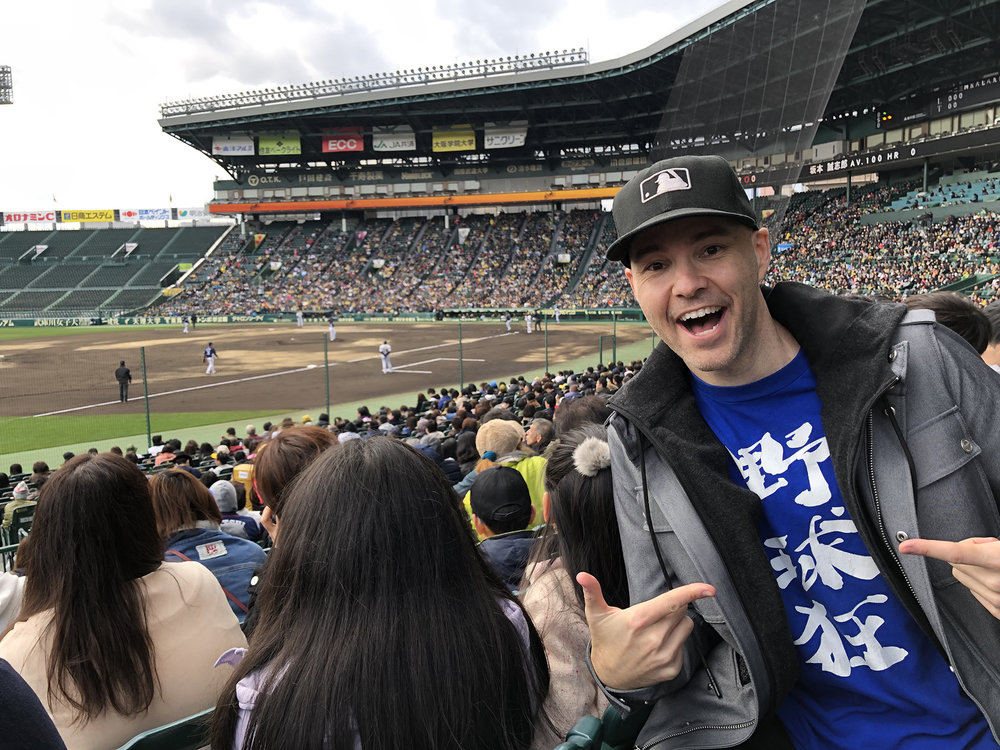
Baseball is America’s pastime, and is one of the few sports where it’s so common to get a baseball from a home run, foul ball, or player simply throwing it up to you in the stands, that it almost appears that a baseball is a collectible with no value. So why would anyone want to collect baseballs for a living? A man named Zach Hample, once regarded by Conan O Brien, as “the worst man in America,” is profoundly known as a baseball super fan and has “snagged” a total of over 11,000 baseballs in 57 Major League Baseball Stadiums. So, before you judge the man of depriving others with the opportunity to catch a ball, lets get to know the story of the man, the myth, and the baseball snagger, Zach Hample.
Born in 1977, Zach Hample is a native New Yorker who has spent nearly his entire life catching and collecting baseballs from major league stadiums. Zach is a baseball fanatic, author, public speaker, and as he puts in his bio on his website, “www.zachhample.com,” an infamous nerd.” Growing up, his dad would take him to games and initially, his goal was to just catch one. As time went on, his goal to catch one slowly turned into not just a love and passion for the game itself, but a mission, to catch more baseballs than any other person had ever caught. On September 10th, 1993, Zach caught a baseball at a game that would start a historic streak for him. In 2017, Zach caught a baseball that would be his 1,000th consecutive game in doing so. Hample has been on multiple baseball pregame shows, radio broadcasts, and late night talk shows including those of Conan O Brien and Jay Leno. Many fans of the game marvel at his determination and passion around the game and his remarkable knack for “being at the right place at the right time”. But, some have a different view and feel that he is attention seeking, selfish, and as Conan O Brien put it, “the worst man in America”. For many this reputation of a selfish, self centered human took a new height on the day of June 19th, 2015.
On June 19th, 2015, Alex Rodriguez, former shortstop and third baseman for the New York Yankees knocked his 3000th hit into the right centerfield stands of Yankee Stadium. The ball went from the hand of pitcher Justin Verlander, to the bat of Alex Rodriguez to the hand of, you guessed it, Zach Hample. Hample was shown on the TV broadcast shortly after the ball landed into his glove screaming in excitement of the moment and the commentators of the game felt that he would willingly give-up the milestone ball for a feat that is extremely rare in the game of baseball. Much to the surprise of the commentators on the Yankee’s Entertainment and Sports Network, media members, and fans, Hample would hold onto and walk out of Yankee Stadium that night without giving the ball to the Yankees organization. This act, blew up the media outlets as this was a milestone baseball in a storied and successful career for Alex Rodriguez, and the man who caught the milestone ball, selfishly, wanted to keep the ball for himself as he stated, “its worth more than my entire collection of balls”. Many fans and sports talk show’s called out sample for being selfish, and disrespectful to not just Alex Rodriguez, but the Yankee Organization for refusing to give the ball back to the team. In other sports like football, a player is usually the one that catches or is carrying a ball during a milestone, or record setting prefromeance, so it is easier for the organization to retain and give or keep the ball or puck within the organization. However, in baseball, if a milestone hit goes into the stands, it’s the fan who has the power in the decision whether to keep or give the ball back depending on how much security intervenes with that fan. As Zach was continuing to receive what some sports talk show hosts claimed as “unwarranted publicity” he eventually made the decision two weeks later to return the baseball to Alex Rodriquez and the Yankee Organization. In exchange for the baseball being returned to the Yankees, the team gave ample a check for $150,000 which was donated to the charity, Pitch in for Basbeball.
Love him or hate him, Zach Hample is a passionate collector of baseballs and continues to attempt to add to his collection today. Hample, currently has a business where he will drive people to baseball games, along with helping them catch a baseball at a Major League Baseball Stadium. Hample’s journey of collecting is long and filled with varying opinions on his intentions of making collection of baseballs his entire life. But at the end of the Day, he is just like you and I, and has found a passion that he hopes to continue and share with other fans of the game many still regard as, “America’s pastime”.
Below is a video posted by Major League Baseball, that profiles Zach Hample, and discusses his collection of baseballs, why he does it, and his thoughts on why he feels baseball is America’s pastime:
Zach Hample Vs The World

“This one’s for John”, were the words spoken by former owner of the Denver Broncos Pat Bowlen after defeating the Green Bay Packers in Super Bowl XXXII. Mr. Bowlen was holding up the Denver Broncos first Lombardi trophy in franchise history and the man he was referring to was Quarterback of the team, John Elway. While, Elway and running back Terrell Davis helped led the Broncos to their first title in franchise history, it felt as though the team wearing white and gold that walked out of reigning confetti at the end of the game was truly and undoubtedly, the better football team.
In 1996, the Green Bay Packers defeated the New England Patriots in their first Super Bowl victory in nearly thirty years and for many people that followed and were a part of the Packer organization, this victory was a rebirth of an organization that had basked in the sun of mediocrity for nearly the last three decades. After their victory in Super Bowl XXXI, it felt that the Packers were destined to repeat as champions the following year as they were led by back to back league MVP, Brett Favre on the Offense, and anchored on the defense by men named Gilbert Brown, Leroy Butler, and Reggie White. The 1997 Green Bay Packers were poised and focused on going back to back when they entered the postseason with a 13-3 record posted in the regular season. In the playoffs, the Packers easily took care of business in the divisional and championship rounds by outscoring their opponents by a total score of 44-17. Green Bay was considered “the team to beat” heading into their second consecutive Super Bowl appearance and went into the game as 14 point favorites against the run- first minded Denver Broncos. The underdog status didn’t seem to bother the Denver Broncos when it was all set and done.
John Elway was more of a game manager later in his career especially when the Broncos had running back Terrell Davis in the backfield. While the memorable images from Super Bowl XXXII are John Elway’s helicopter flip to gain a critical first down, late in the first quarter and Terrell Davis driving himself up and down the field on the Packers defense, it was another image from this game that could’ve turned the fortunes toward Green Bay. Late in the fourth quarter, the Denver Broncos scored a go- ahead touchdown in which Terrell Davis essentially walked into the end-zone standing up right giving Brett Favre one last opportunity to drive down the field for the tying score. What many overlooked in this sequence was that it was Green Bay head coach, Mike Holmgren’s intention to let Denver score because he felt it was the only way the Packers had a shot to win this game. Hold on a minute, Green Bay was one of the best defenses in the NFL in 1997 and your only chance to win was letting or basically giving Denver a touchdown? Strategically to some, it did make sense to allow Denver to score the go ahead touchdown, so Brett Favre and company would have enough timer to drive down the field and not win but tie the score and potentially force overtime. However, Holmgren could’ve put his foot in the ground, put some trust in his defense, and decide to attempt a goal line stand to force a field goal. This would’ve given Green Bay a chance to drive down the field for the win and even if they couldn’t get down to the end zone in time, they could set up a potential game tying field goal.
Green Bay would go on to lose this game which would also signify the last Super Bowl appearance for Brett Favre the rest of his career. While many feel Denver was destined to win this game and that it was John Elway’s time, I still feel Green Bay was the better team. Contrary to what many believe that the better team always wins, sometimes the better team loses and we have to accept it, move on and look forward to the next season. Although this is the right attitude to have, as a Green Bay Packers fan, I will always have the words tattooed into my mind, what if.
Many people say that when it comes to the National Football League, the Dallas Cowboys are “America’s Team”. While this monicor is simply a matter of opinion and was orignally a nickname given by fans and media members alike, fans of the game depending on what team a fan calls theirs will differ. While I try to stay unbiased make an effort to showcase peices of sports memorbilia from all sports and teams, the Green Bay Packers will always be my favorite team and in my opinion, “America’s Team”.
If you don’t already know, the Packers have had three window’s in their history of unprecedented dominance and success and with each one. A unique and special story can be told about the teams that dominated the rest of the NFL during their respective era’s. For each era, there are sports collectibles that symbolize and can be associated with the teams that between the three era’s, compiled 7 world championships and 8 championship game appearances. Of all of the collectibles and memorabilia that has been associated with these Packer teams, their is one from each of Green Bay’s “eras of dominance” that I and many sports fans could see best represent the Packers three modern football era’s of greatness.
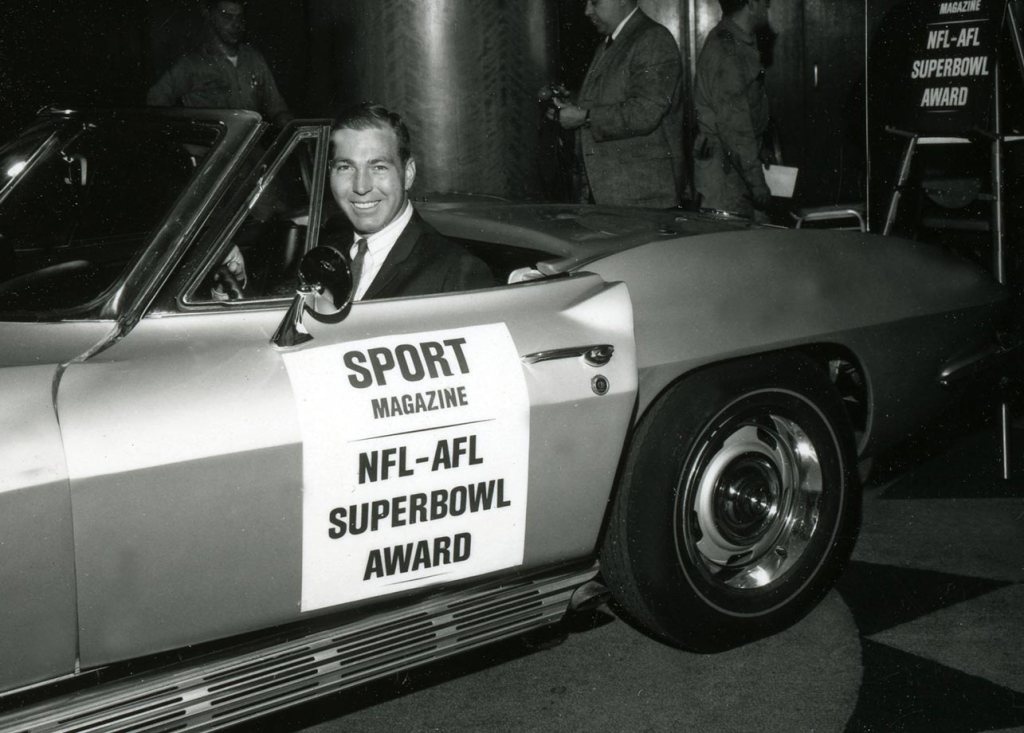
In 1967, The Green Bay Packers were world champions of football after defeating the Kansas City Chiefs 35-10 in Super Bowl l. At the time, the game was known as the NFL-AFL Championship game and would later be renamed the Super Bowl. At the time, the win in Super Bowl l by the Packers was history as no team in professional football had ever won three consecutive championships. The Packers accomplished this feat with the determination and relentlessness of head coach Vince Lombardi and 11 players who would later be inducted into the Pro Football Hall of Fame. Of the 11 hall of famers the Packers had throughout the 1960’s in which they won 5 world championships, the MVP of Super Bowl l was their quarterback, Bryan Bartlett Starr.
In Super Bowl l Bart Starr finished the game by completing 16 passes in 23 attempts for 250 yards, two touchdowns, one interception, and a passer rating of 116.2. While other players that could call themselves world champions that day, there were other deserving candidates for the Super Bowl MVP award such as Max McGee, who caught 7 passes for 138 yards and two touchdowns. However, it was their 17th round pick from The University of Alabama in 1956 that showed the NFL that he wasn’t just a game manager and that he had thew ability to rise up for the occasion on the game’s biggest stage. For winning the Super Bowl MVP, Starr was awarded a Green 1967 Chevrolet Corvette convertible which later became a tradition for winners of the Super Bowl MVP award. Starr was always a team first man and only kept his MVP vehicle for a short time before selling the Vehicle. In may of 2018, the Corvette Starr had sold nearly 50 years prior was displayed in Green Bay by the current owner of the vehicle, Micheal Anderson of Thunder Valley Classic Cars in Minnesota. This car symbolizes the efforts of Bart Starr during Super Bowl l and how determination, leadership, and heart are what make a team not just talented and a winner, but a dynasty.

After nearly 30 years removed from their last Super Bowl win, the Green Bay Packers led by quarterback Brett Favre and head coach Mike Holmgren returned to glory when they defeated the New England Patriots in Super Bowl 31 by a score of 35-21. The 1996 season was Green Bay’s best season since 1967 and Brett Favre is famously known for bring the pack back to NFL prominence and a team that could once again be known as dominant. This collectible is a blue unused ticket stub with a New Orleans themed ticket stub due to the game being hosted in the Mercedes Benz Super Dome. This venue had significant importance to Brett Favre as he grew up an hour away from the stadium which allowed many of his family members to come to the game and support the packers quarterback in one of the shining moments in Green Bay history. This ticket reminds people of New Orleans and the culture of music, joy, and celebration all being showcased on the ticket stub. The Packers were back, and for the majority of time moving forward, the Packers have continued to find ways to stick around as a relevant postseason contender. After Favre left Green Bay at the conclusion of the 2007 season, their was a new quarterback into town that the organization felt would help continue the Packers prideful legacy and eventually return them back to the Super Bowl. His name is Aaron Rodgers and during their 2010 championship run, a certain celebration created a piece of memorabilia that will forever be associated with the 2010 team and the perseverance and relentlessness they showed.
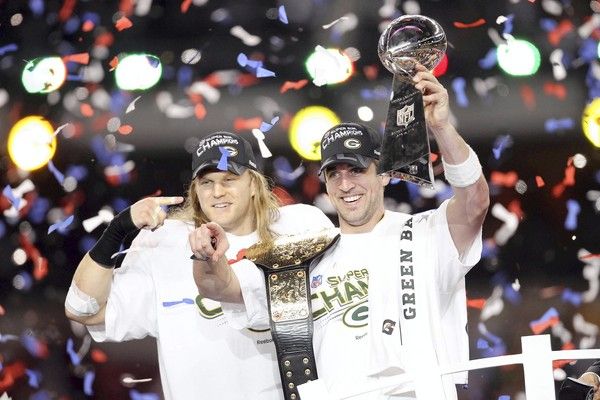
Aaron Rodgers was always slighted by the fact that people always thought that he wasn’t very athletic. So, during the 2010 season on their way tho their 4th Super Bowl win in franchise history, whenever Aaron ran for a big gain or a touchdown, he broke out the now famous, “Aaron Rodgers belt celebration. This celebration stemmed from Aaron’s doubted athleticism and his love for WWE. In honor of their victory in Super Bowl XLV, linebacker Clay Matthews presented Aaron with a championship belt of his own which is now a symbol of the 2010 season and the way in which Green Bay proved doubters wrong and became only the 6th wild card team in NFL history to win the Super Bowl. This belt has been replicated and signed by Rodgers by himself and can be found online for sale at $1,199.99. The belt is a WWE heavyweight champion belt and in the year of 2010, the Green Bay Packers showed thew entire world they were true and deserving heavyweight champions.

1869, Cincinnati, Ohio- this is where the game of professional baseball originated and 150 years later, the game of baseball has been established as not only America’s pastime, but the original sport for fans to watch, idolize, and root for their favorite baseball team and favorite players. Fans and followers of the game very early on in the games existence had a way to interact and get involved with the players and important figures of the game, and this was collectible baseball cards. What started out as team photos glued to a piece of cardboard have grown into a passionate collectible hobby with deep roots spanning back to the mid 1800’s.
Due to the historical and cultural impact the game of baseball has had on America, baseball cards that people could get nearly for free in the early years of baseball have price tags in the thousands and even hundred thousands today. The first ever baseball card that was produced was a team photo of the Brooklyn Atlantics in the year 1865. At the time, Major League Baseball wasn’t even officially established but teams around the United States and regionally still held competitions within a non-established baseball league. For many, a baseball card was no more than what it was, a piece of cardboard with a photo glued to the front of it. The first baseball card was given to fans of the Brooklyn Atlantics before some of their games, and in 2013, the card that was given out as a giveaway with the price of admission was sold for $92,000. Baseball cards began to become more frequently produced and distributed to fans in the mid to late 1800’s which gave other industries an opportunity to partner with baseball and start including cards within their company’s product packaging.
In 1875, tobacco companies started putting baseball cards produced by Old Judge and Allen & Ginter free inside packs of cigarettes which at the time was a industry that had almost unlimited free range in advertising among radio, print, and stadium billboards. The health risks of cigarettes were not known of in the 1800’s and it wasn’t until 1970, almost a century after the first baseball cards were put in cigarette packs, that adverting of cigarettes on radio and TV were officially banned by the United States congress. While cigarette packs were the first form of an alternative industry promoting the game of baseball through inclusion of baseball cards in their products, baseball cards would continue to pop up in other industries packaging and continue so for many years to come.
At the turn of the century, in the 1900’s the game of baseball was gaining popularity among people in the United States and the organization of professional baseball was growing as a result of increased national popularity. With the game gaining popularity in the U.S, fans of the game were creating a demand for collectible items that were connected to the game in some way, shape, or form. In 1914- 1915 industries such as popcorn and a candy coated food referred to and popularized as “Cracker Jacks”, began putting a baseball card inside every package of their products. These cards were considered as a prize or an incentive for buying a box of popcorn, or Cracker Jacks and at the time, were just a card of a player or team photo, but became a hobby for many fans of the game. Fans would purchase a pack of Cracker Jack’s and begin collecting all of the cards they would get from the inside of the packaging. In the early 1930’s more products such as bubble gum would include baseball player cards and for the first time, people could see player stats on the front and back of them. This practice stuck and was used on some of the most notable and famous players at the time of production. With the rising popularity of the cards, the cards themselves began to change and evolve which led to newly invented features such as the “die cut”. The “die cut” was a feature in the baseball cards that gave them the ability to fold over the top and stand on their own. This gave people a way to take all of their baseball cards and stand them up on a shelf to show off their collectible displays instead of just stacking the cards or laying them out.
When the United States entered WW ll, production for many industries across the country went down and more production went towards producing military equipment and supplies that would be sent overseas and to stationed soldiers around the world. At the end of the war, baseball cards began to comeback as they were introduced in packages of Bowman’s gums and were called “leaf cards”. Unfortunately, the cards themselves had a very short shelf life as many of them were damaged or wrecked by the gum and powder from the stick packaging they were placed in. In the early 1950’s a company named Topps revolutionized the production and selling of baseball cards and become one of the most iconic and well known brands for the making of them. Baseball cards were well known at the time Topps entered into the card making competition, but Topps, unlike other manufactures of the product, would last thought the rest if the 20th century and become a company that is still known in the United States as iconic and well standing collectible making company today. Some of the cards that Topps made in the 1950’s such as the #311 Mickey Mantle, are being sold today for six figures. Topps, like many card making companies, would begin trying out new variations of their cards with cool innovative features such as the introduction of 3-D into their cards in 1968. While baseball cards at this time were only being known for collecting, they would soon begin being regarded in a term many had never even thought to associated with these chewing gum collectibles, value.
In 1979, a man by the name of James Beckett published the first ever baseball card price guide. This guide took cards that were made over the years and assigned value to each one depending on the player, the style, authenticity, condition, and many either features that added or took value away from the cards. This guide changed the way that people viewed baseball cards and it increased the age demographic of people who were interested in collecting them. Collecting of baseball cards slowly shifted from a childish hobby, to an adult hobby and while kids still collected baseball cards, many of them would hold on to them as they would become of some value many years later. The more that the game of Major League Baseball gained increasing national recognition, the more value cards from the game’s first 50 to 60 years increased in value. The hobby of collecting was evolving, and so were baseball cards themselves.
When cards began gaining value, Topps, and other companies began working on ways to make their cards stand out more and be more geared to investment- minded collectors. In 1989, Upper Deck Cards unveiled product features including, glossy cards, tamper proof packaging, a holographic logo, and intentionally low print runs. Features like these continued to be a part of baseball cards for the next quarter century with more value adding innovation such as players wearing game worn jerseys, cards with player signatures on the front, etc.
Baseball has come a long way from where it began over 150 years ago, but the creation, growth, and innovation of baseball cards has helped in keeping an interest in the game and the players that made it America’s pastime. In 2013, Topps made and displayed a 90 ft by 60 ft player card of MLB first baseman Prince Fielder. It was laid out across across a little league outfield and it was a display that reminded people how much baseball is still idolized and cherished not only by the youth that play and follow the sport today, but the adults young and old that grew up collecting cards and integrating themselves into the game many still regard as “America’s Pastime”.

Every professional sport has pieces from its history that are considered collectibles or pieces of memorabilia that have or will have increasingly more value as time goes on. There are a lot of sports fanatics and collectible junkies that enjoy finding and collecting pieces of memorabilia from professional sports because they hold either an emotional value to the person or a historical significance that person finds intriguing. There are thousands of sources that sports memorabilia can be obtained from all over the globe but how do you really know what is truly authentic and what is just a replica? This blog will be detailing in steps how to identify that a piece of sports memorabilia is truly authentic and not just a replica. While there are a lot of different outlets that sports memorabilia can be searched for, I’ll be focusing on memorabilia that can be found via the web.
Step 1: Select a specific piece of memorabilia that you want to find
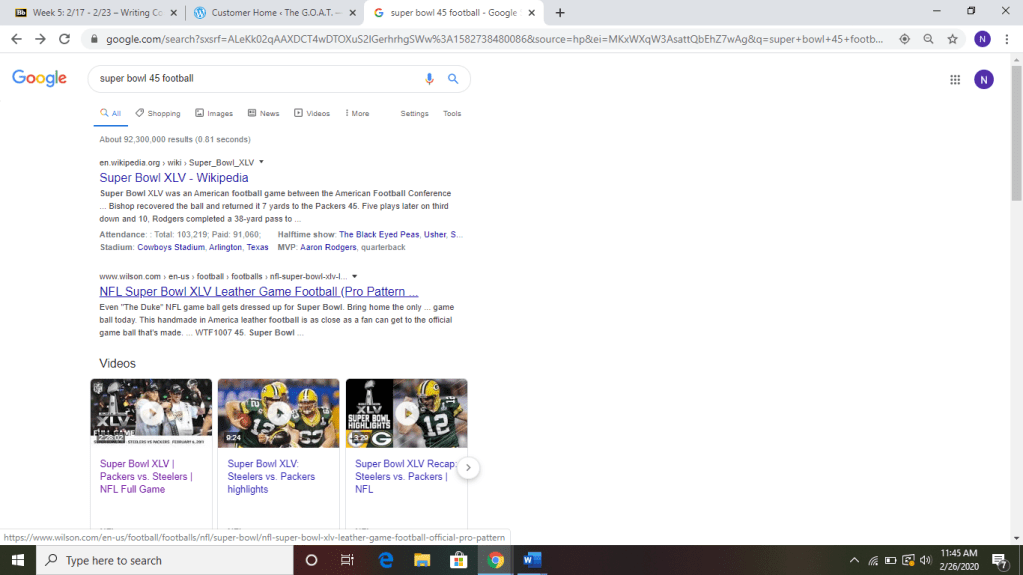
Usually when your searching for a piece of sports memorabilia on a search engine such as Google, its not uncommon to get hundred of pages that claim they have what your looking for specifically. Unfortunately, a lot of these pages will direct you to a replica or a similar piece of memorabilia from the one you were looking for. To get a more accurate search result from Google, select a specific piece of memorabilia that is only tied to one game, or one event. That way, if you have a specific piece of memorabilia in mind, you will be able to use specific keywords to help narrow your search and increase your chances of finding what your looking for.
Step 2: Narrow your keyword search

When finding a piece of sports memorabilia using Googles search engine, its important that your search has relevant keywords that through Googles search engine optimization, will narrow your search and the first page of results will display the sites with the best chance of having the exact piece of memorabilia that you are looking for. For an example, if you wanted to find a game used football from Super Bowl XLV, by typing in, “Superbowl 45 football” the top results wouldn’t give you a site where you could actually buy a game used football. For Google’s search engine to know specifically what your looking for, you need to give them specific information. By specific, its important that you give google the name of the event, the piece of memorabilia your looking for, and since your looking to purchase a piece of memorabilia, ending the search with the words “for sale” is ideal. With this in mind, a keyword search for a game used Superbowl 45 football would look something like, “Superbowl XLV game used football for sale”. When you type this keyword search in, literally the first result is an auction website that has a verified authentic Super Bowl XLV game used football for autction.
Step 3: Look for information on the site that verifies authenticity
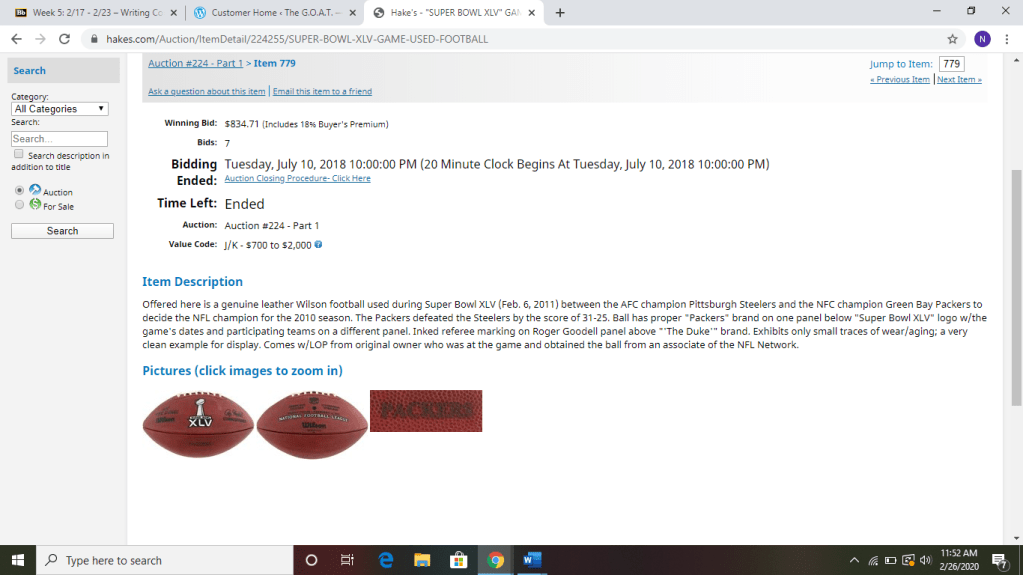
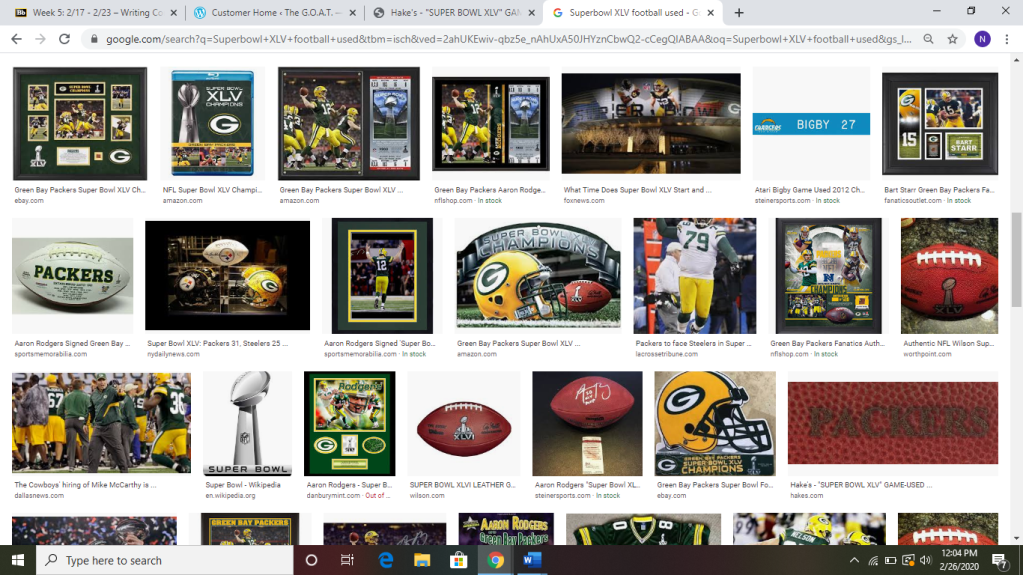
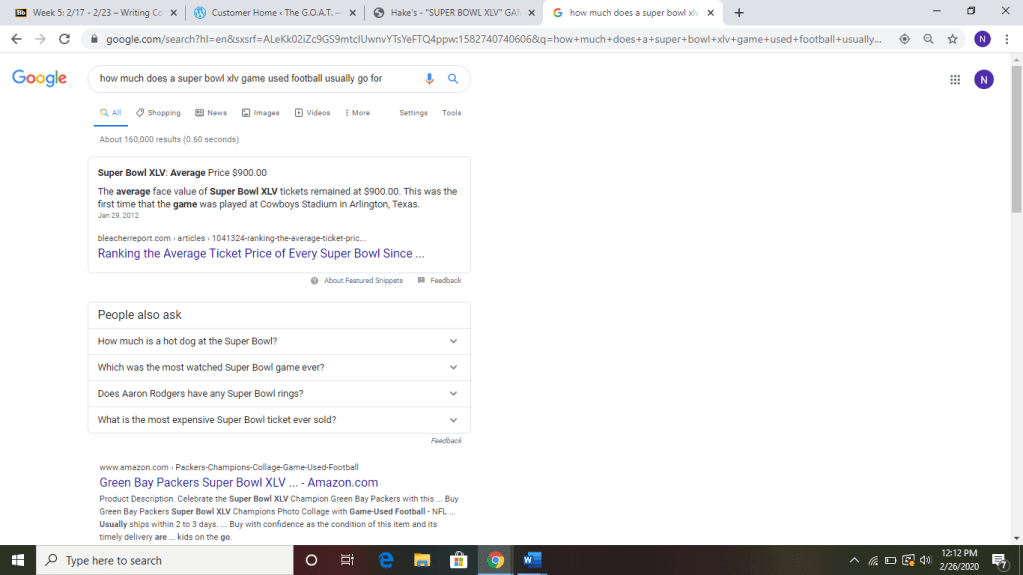
When you click on the first result after narrowing and specifying your keyword search, investigate the website a little bit by looking for key authenticity versifiers, such as fact checking that the piece for sale first looks exactly like an authentic piece. For this example, try going back to Google and under the images tab search “Superbowl XLV”. This will lead you to the search results page shown below where there are action shots of the game balls being used where you can see if the footballs being used match the one from the auction site. Another way to verify the piece’s authenticity is reading the description to make sure the writing looks professional with no errors or questionable dialogue that might not historically match with that of the event. One last action you can make to verify authenticity is to make sure the price being asked from the seller matches or is close to the value of that specific piece. For a game like the Super Bowl, there are many different balls used throughout the game, so going back to Google and searching how much the piece of memorabilia typically goes for will further verify that the website you landed on is indeed selling you an authentic piece of memorabilia. After taking several measures, such as these to verify the memorabilia’s authenticity, you are ready to place your bid and go for the piece of memorabilia you’ve always been wanting to have.
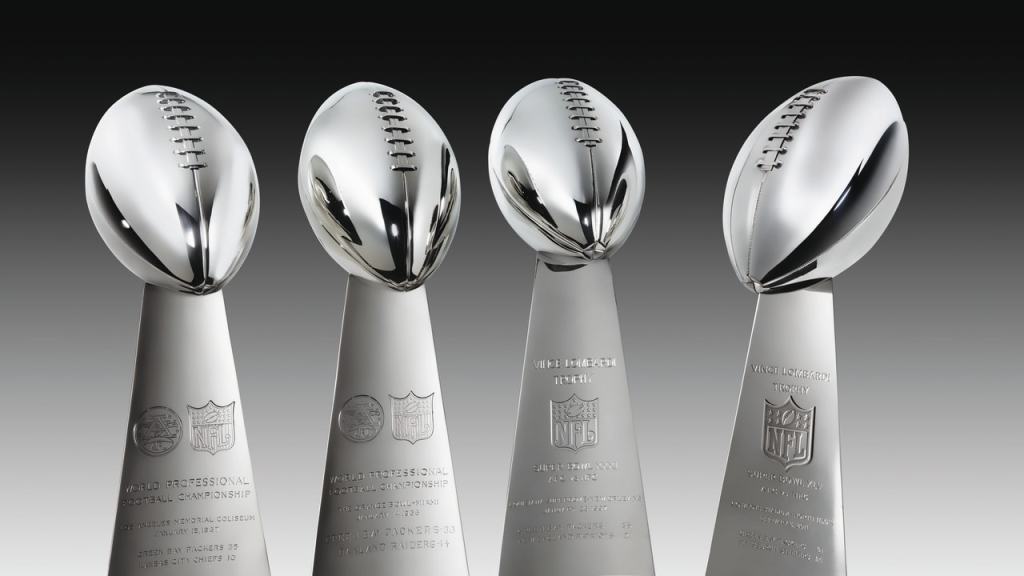
The day was February 6, 2011- a day that will forever be my greatest sports memory. The Green Bay Packers are the third oldest franchise from the National Football League and while they initially formed in 1919 by Indian Meat Packing worker Curly Lambeau and Green Bay Press Gazette editor George Whitney Calhoun, the team officially entered into what was formerly known as the American Professional Football Association in 1921. The league was later renamed the National Football League in 1922, but it wouldn’t be another 44 years until the Packers would change NFL history and create the root of my passion for the Packers forever. In 1966, the Green Bay Packers won the first ever Super Bowl which then was named the AFL- NFL Championship where the two competing leagues held a competition between the winner of each respective league. This game would later be dubbed by media members as the Super Bowl, but their was was still a lingering question about the big game that millions of people gathered around their TV’s, mobile phones, and laptops, to enjoy with friends and family every year. See, up until the year 1970, the winner of the Super Bowl was awarded the NFL- AFL championship trophy; built every year by Tiffany and Co. Once the NFL and AFL merged into one league, the name of the trophy was in need of a different name and in the year 1970, the NFL decided to rename the Super Bowl trophy after the man who took his team to the first two big games and won each time. That man’s name was Vincent Thomas Lombardi. The trophy that was awarded to the winner of the Super Bowl each now engraved the name of the coach that made the Green Bay Packers a sports dynasty in the 1960’s and a team that would be a part of sports history for eternity.
Now, in my previous blogs I had mentioned how much of an important part the Packers are to my parents and the city of Green Bay. To say that important could be used to describe my parents love and passion for their hometown team would be a ridiculously large understatement. My parents attended games, watched games on TV, and stuck behind the Packers through the early stages of their lives when the teams was enduring two and a half decades of below average to middling mediocre play on the once revered frozen tundra. Green Bay couldn’t seem to get it right and my parents along with the rest of the city of Green Bay watched and supported them through thick and thin until finally in 1996, the team previously viewed by the rest of the league as a laughing stock, would return the Lombardi Trophy to the city that could once again could be embraced as Title-town.
The day was February 6th, 2011, a day that will forever be my greatest sports memory. On this day, The Green Bay Packers played the Pittsburgh Steelers in Super Bowl 45. Similar to their last Super Bowl victory after a more than extended hiatus from the big game, I, much like my parents was jubilant, enthusiastic, and thrilled to watch my favorite sports team get a shot to bring the Lombardi trophy back home. Former Packers head coach and winner of Super Bowl 31 once said, ” As important as it is to any other player or any other team, it means more to us”. That quote from the coach that led the Packers to their first Super Bowl win in nearly three decades was the feeling of not just myself, but every person who’s fandom was tride and true to the green and gold. That day, My mom, brother, longtime family friends Tony and Lindsay, their newborn baby Chloe, and I sat around a living room TV in my childhood home at 3848 Knapp St. Rd. to watch the Green Bay Packers play in North Arlington, Texas. At around 9 pm central time, the stage was set, the Steelers had the football on their own 33 yard line with 55 seconds left in the game. It was 4th and 5 and if the Packers defense, who had been tough and resilient all season long could make a stop, the Packers would be able to run the clock down to zero seconds and would bring their 13th championship and 4th Super Bowl trophy to the city of Green Bay. My mom brother, and I were standing in our living room my hand holding my moms and my brother hands tented up on his face. “Please, one more stop” was my the thought circling through my head. It was time, Roethlisberger took the snap from his center, hesitated for a couple of seconds then fired one last desperation throw to wide receiver Mike Wallace. In a split second the ball went through the hands of Wallace and fell innocently into the turf of AT&T Stadium. Jubilant, pride, excitement; there weren’t enough words to capture this moment as my mom brother, and I all jumped off the living room floor and exchanged hugs and joyful tears. It was at that moment in time that a figure in sports I usually despise, Joe Buck, said the words all Packer fans woke up wanting to hear, “The Green Bay Packers… have won the Super Bowl.

 The G.O.A.T.